

















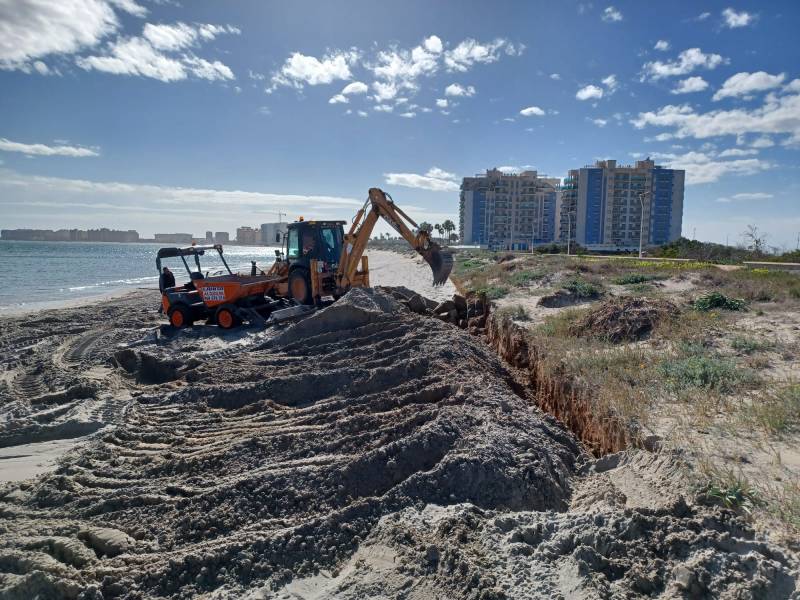
Nature has scored an important win in the dunes of La Manga as the battle over this undeveloped stretch of coast continues. Work has begun to protect this fragile section of the coastline, removing invasive plants and replanting native species to strengthen the dunes. The Ministry for Ecological Transition and the Demographic Challenge (MITECO) has started on six dune areas to improve the coast’s natural defence against erosion.
The first phase covers the stretch between the Canal del Estacio and Veneziola, in San Javier, and is part of the Priority Actions Framework to Recover the Mar Menor (MAPMM). The project has a budget of €210,000 and should take eight months, funded by the Recovery, Transformation and Resilience Plan.
Invasive plants like ‘uña de gato’ or Cat’s Claw (Carpobrotus edulis) will be cleared, and native dune plants will be reintroduced. That includes Mar Menor asparagus (Asparagus macrorrhizus), sea fennel (Crithmum maritimum) and sea lily (Pancratium maritimum). The Mar Menor asparagus, found only in this area, has been classed as endangered since 2023 because of coastal development.
Wooden posts and rope will keep people and vehicles off the restored areas, and invasive plants will be removed every four months for at least four years.
The project covers six zones: two on the Mediterranean side (Ensenada del Esparto North and South) and four along the Mar Menor (Playa Chica and Veneziola North, Central and South). Existing dunes will be reinforced, new bands of vegetation planted, and debris or old concrete removed to give these delicate ecosystems a real chance to recover.
This area on the Mar Menor has been under the spotlight for years. Locals, scientists and environmental groups have long warned about pressure from development on and near this spot and invasive plants. They have organised many protests over the years for more work to protect this natural landscape and to stop building work to help these fragile areas recover.
Image: MITECO