To be listed on the CAMPOSOL TODAY MAP please call +34 968 018 268.
article_detail
Date Published: 21/07/2026
The Canary Islands are now experiencing calima on almost five months of the year, and it's getting worse
A major new study shows desert dust affecting the islands on 40% of all days, with health experts warning of serious consequences for vulnerable people
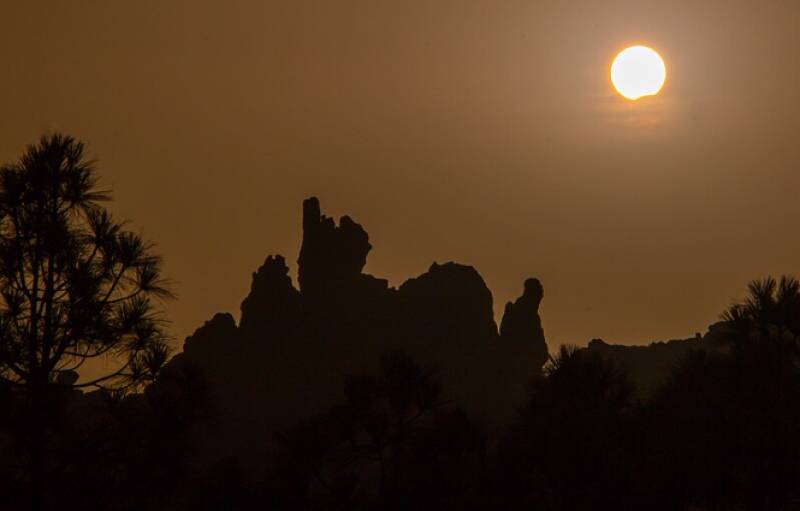
If you've spent time in the Canary Islands and noticed the sky turning a hazy orange-brown, the air feeling thick and gritty, and visibility dropping across the landscape, you've experienced calima. It's the name given to the waves of fine Saharan dust that blow in from North Africa, carried by the trade winds, and it's a phenomenon that anyone living in or visiting the islands is likely to encounter at some point. What a new scientific study makes clear is that it's now happening far more often than it used to.
Research published in the journal Nature by the Paul Scherrer Institute in Switzerland, carried out in partnership with IDAEA-CSIC, analysed data from more than a hundred European measuring stations over the last decade. Its findings are striking.
The Canary Islands experience calima on around 40% of all days, equivalent to roughly 146 days a year, nearly five months. Meanwhile, the south of the Iberian Peninsula is affected on around 35% of days, and the northeast between 25% and 30%.
Xavier Querol, a researcher at the Spanish National Research Council and co-author of the study, explains that the trade winds typically carry African dust towards the Caribbean and that this current passes directly over the Canary Islands. When an anticyclone settles over North Africa or a low-pressure system develops near Cape St. Vincent, that dust gets pushed northward towards Spain.
The researchers link the increasing frequency directly to climate change. Warming caused by greenhouse gases is drying out large areas of North Africa and accelerating desertification, effectively sending more dust airborne more often. Querol also notes that the dust particles don't always travel alone, and can carry pollutants from North African factories where emission limits are far less strict than in Europe.
The most alarming episodes on record came between 2020 and 2022, when the islands experienced what scientists call "super calimas." A normal dust intrusion leaves particle concentrations of between 200 and 400 micrograms per cubic metre. During those extreme events, levels in Gran Canaria reached 1,840 micrograms, more than thirty times the EU's recommended daily limit of 50 micrograms.
The health consequences are real. High Saharan dust concentrations have been linked to increased hospital admissions and higher rates of death from heart attacks and respiratory illness. Research from the University Hospital of the Canary Islands found that heart failure patients fared worse when they'd been exposed to Saharan dust in the days before hospitalisation.
Health authorities recommend that anyone with asthma, COPD or a heart condition checks the AEMET forecast before going outside during a calima warning. Symptoms can include severe coughing, shortness of breath and chest discomfort, and the risk of respiratory infections rises significantly during heavy dust episodes.