















The poor old Mar Menor may finally be turning a corner. A new report from the Spanish Institute of Oceanography (IEO-CSIC) shows the first signs of recovery in the lagoon’s native seagrass beds after nearly a decade.
The document, Mapping of the Mar Menor’s Seagrass Meadows 2024, released on December 11, 2025, updates a monitoring programme that started in 2014. It confirms what scientists have been saying for years: the ecosystem is still heavily affected by the 2016 collapse, when extreme murky water caused the loss of around 85% of its underwater vegetation. However, for the first time since then, researchers have seen small but encouraging signs of recovery in the two native seagrass species, Cymodocea nodosa and Ruppia cirrhosa.
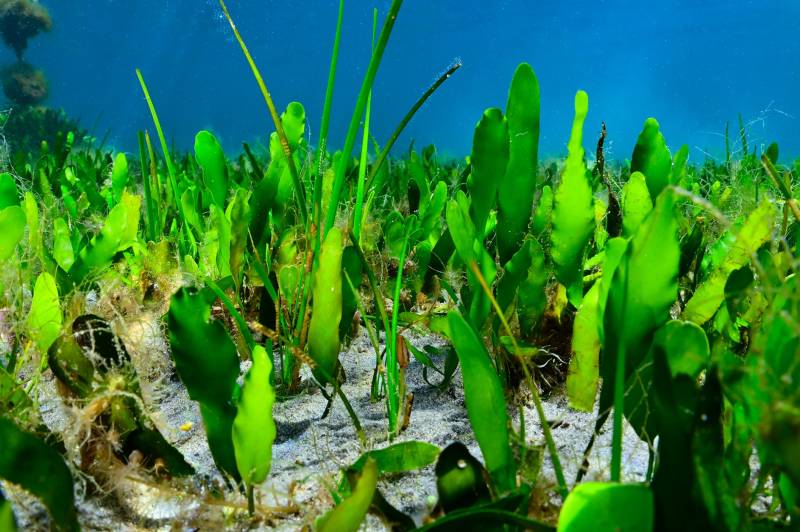
The report shows that Caulerpa prolifera still dominates the lagoon, covering around 86% of the seabed. This is slightly less than in 2022, reflecting the ongoing effects of the “white spot” or whiting phenomenon first observed in 2022. This happens when large amounts of calcium carbonate settle from the water. This means that around 711 hectares in the central-western part of the lagoon are without vegetation.
Despite these challenges, there are signs of progress. Cymodocea nodosa still covers about 14.5% of the Mar Menor, similar to post-crisis levels, but the 2024 mapping shows it has recovered 175 hectares since 2022. Most of this growth is along the eastern coast, from La Encañizada to the Estacio channel, and in parts of La Manga, where clearer Mediterranean water helps. The recovery near the Marchamalo canal stands out, with the species returning to depths of more than four metres for the first time since before 2016.
Ruppia cirrhosa also shows a noticeable improvement. After shrinking to just three hectares between 2017 and 2022, it now covers 32.5 hectares.
Even though there has been improvement the outlook is still fragile. The IEO says the lagoon is under serious pressure from high nutrient levels, the spread of Caulerpa prolifera, the ongoing white-spot phenomenon and warmer water temperatures. All of this makes it harder for the native seagrasses to bounce back and keep the lagoon in balance.
At the current growth rate of just over 7% a year, researchers say a full recovery of Cymodocea nodosa could take more than ten years, and that’s only if nutrient levels are cut and kept low over the long term.
Image 1: canalmarmenor.carm.es
Image 2: IEO