













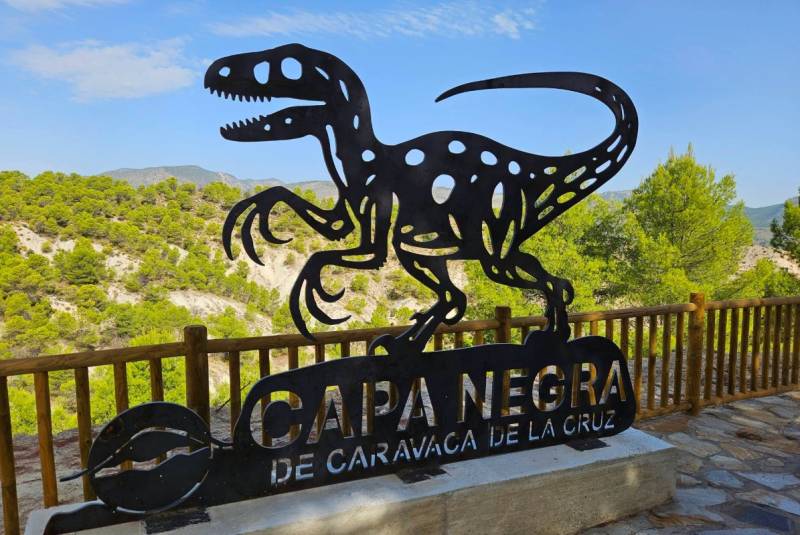
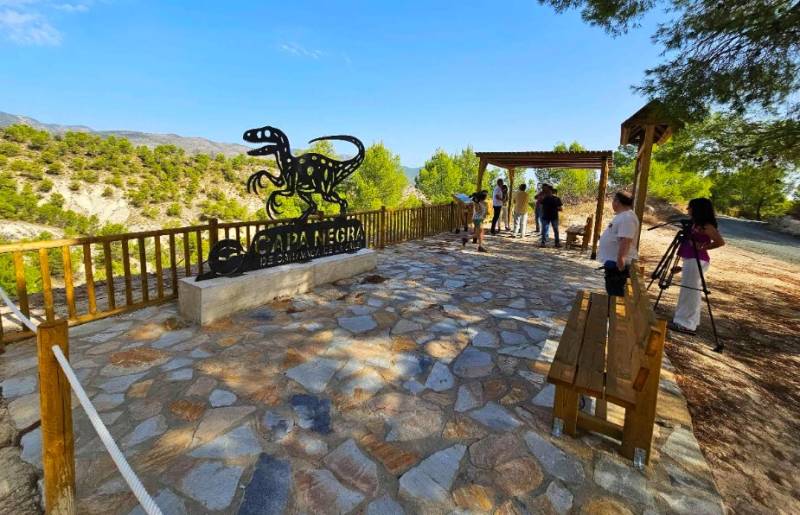
 The Town Hall of Caravaca has created a viewing point in the gully of the Barranco del Gredero, one of the most important locations for the study of geology in Europe if not the world.
The gorge is located very close to the RM-711 road leading south-west out of Caravaca, on the right as you head out of town towards the village of La Paca (click for map) and the new viewing point there is intended to commemorate the spot and attract more visitors to this part of the countryside. At the same time, the condition of the old Camino Real de Granada has been improved, providing an obvious path for hikers to follow.
At around 73 square metres, the viewing point is not a major venue, but an attractive spot to stop and admire the view, although the true interest for geologists requires a far closer inspection.
 The Black Layer, or “Capa Negra”, is a band of sediment which was deposited all over the planet containing high levels of organic material and iridium, and dates from approximately 66 million years ago, marking the boundary between the geological period of the Cretaceous and the Paleogene. The evidence points to it having been caused by the massive asteroid impact in the Yucatan area of Mexico which led to the mass extinction of the dinosaurs and the majority of other animal species all over the world.
The Barranco de El Gredero in Caravaca is acknowledged as being one of the best places in the world to see and study this phenomenon, along with two others in Spain: Agost, in the nearby province of Alicante, and Zumaia, in Guipúzcoa (Basque Country).
At the same time, the location has been named one of only five Natural Monuments in the Region of Murcia, along with Monte Arabí in Yecla, the Gredas de Bolnuevo in Mazarrón, the Sima de la Higuera in Pliego, in the Sierra Espuña, and the Salto del Usero in Bullas.
Going back even further in time than the Capa Negra, close to the nearby River Argos a “golden spike” marks the limit between the Hauterivian and Barremian periods, approximately 125.77 million years ago. The two phenomena combine to make this one of the most advantageous areas on the planet to study the geological evolution of Earth.
Images: Ayto Caravaca
For more local news, events and visiting information contact the local tourist office (telephone 968 702424) or go to the home page of Caravaca Today.
 More information about the places of interest which can be visited in the municipality of Caravaca de la Cruz, along with what's on and local news can be found in the Caravaca Today.
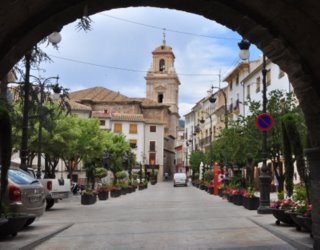
Caravaca de la Cruz, in the north-west of the Region of Murcia, is one of only 5 Holy Cities in the Roman Catholic world, a centre of pilgrimage, along with Rome, Jerusalem, Santiago de Compostela and Santo Toribio de Liebana, and is home to the Cross of Caravaca, the Vera Cruz.
The status of Holy City was bestowed by Pope John Paul II in 1998, granting the City a Permanent Jubilee year every 7 years for perpetuity, the first one held in 2003 and the next in 2024.
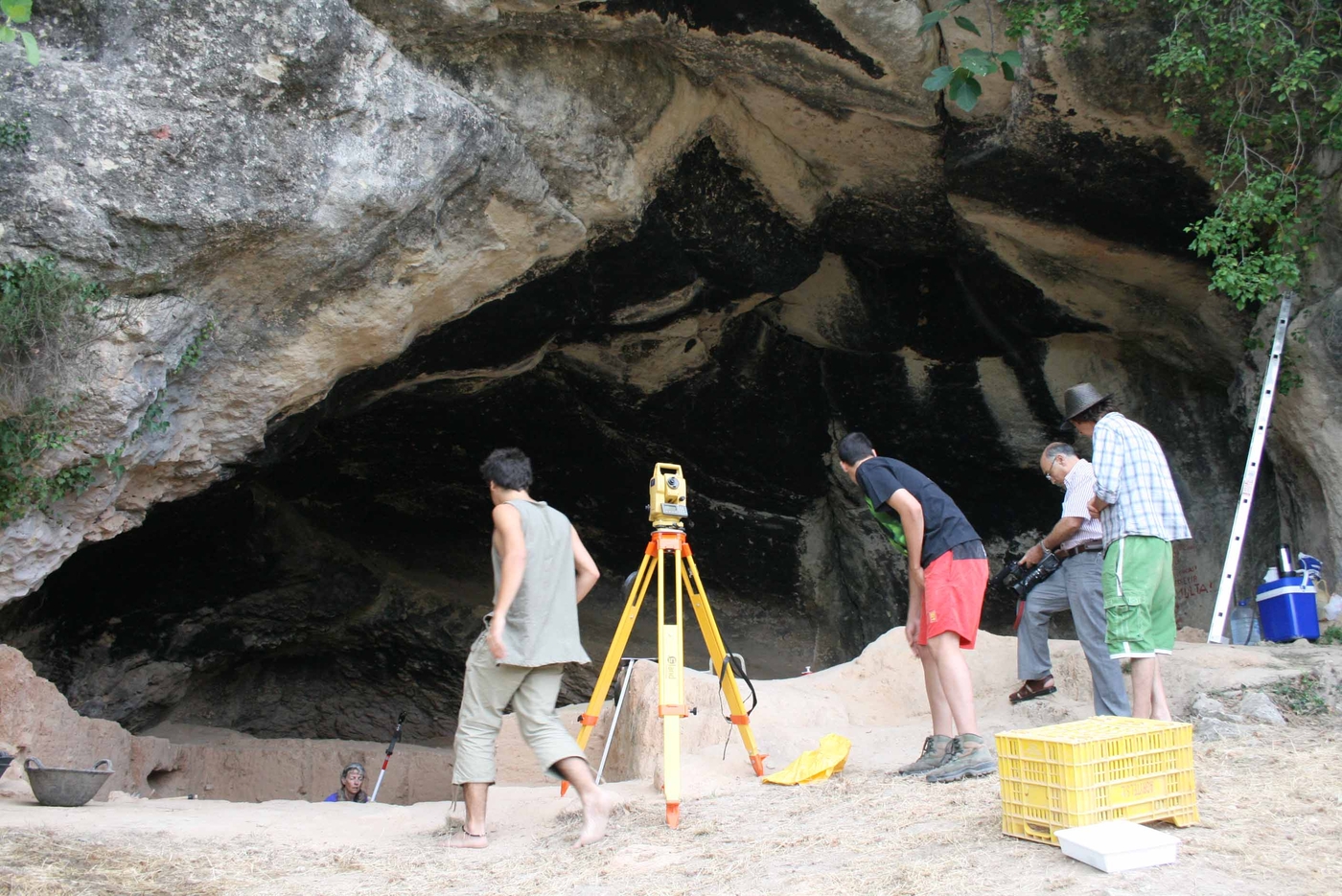
The strategic and natural advantages of Caravaca de la Cruz have attracted the attention of settlers for more than 800,000 years, the Cueva Negra yielding remains of Homo Heidelbergensis, forbears of the Neanderthals and the municipality also houses important archaeological remains from the Argaric, Iberian and Roman cultures. many of these can be seen in the Municipal Archaeological Museum.
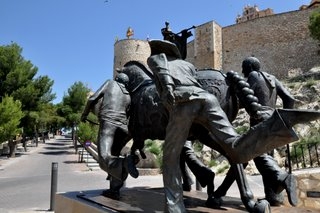
 As a border town caught between the Catholic forces of Castille and the last remaining Moorish stronghold in Spain, Granada, Caravaca had a turbulent medieval history, but it was during this period that the legend of the Cross of Caravaca was born, bringing the religious orders which shaped the structure of Caravaca today, with its impressive hilltop castle and eclectic collection of churches and monasteries, religious tourism today being a backbone of the town´s economy.
Caravaca de la Cruz is a municipality with important natural resources, including extensive forests, part of which have protected status due to their wealth of flora and fauna, and due to the abundant water supplies is also a major area for canned fruit production, apricots in particular being an important crop.
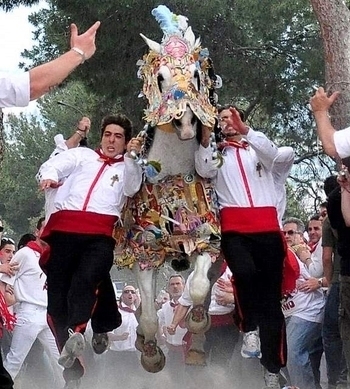
 Caravaca is renown for its important May Fiestas, held in honour of the Vera Cruz, which also incorporate the Moors and Christians celebrations and the Running of the Wine Horses.
Caravaca de la Cruz is also the home of Europe´s largest collection of ethnic instruments at Barranda, the Museo de Música Étnica Barranda and is the location of the Barranda festival de Cuadrillas, which celebrates the Region's ethnic music traditions.
The municipality is home to around 26,000 inhabitants and shares boundaries with Moratalla, Cehegín, Lorca, Puebla de Don Fadrique in the province of Granada and Vélez-Blanco in the province of Almería.
Tourist office opening times:
Weekdays: 10.00 to 14.00 and 16.30 to 19.30
Saturdays: 10.30 to 14.00 and 16.30 to 19.30
Sundays and public holidays: 10.30 to 14.00
Click for map, Caravaca de la Cruz Tourist Office