


















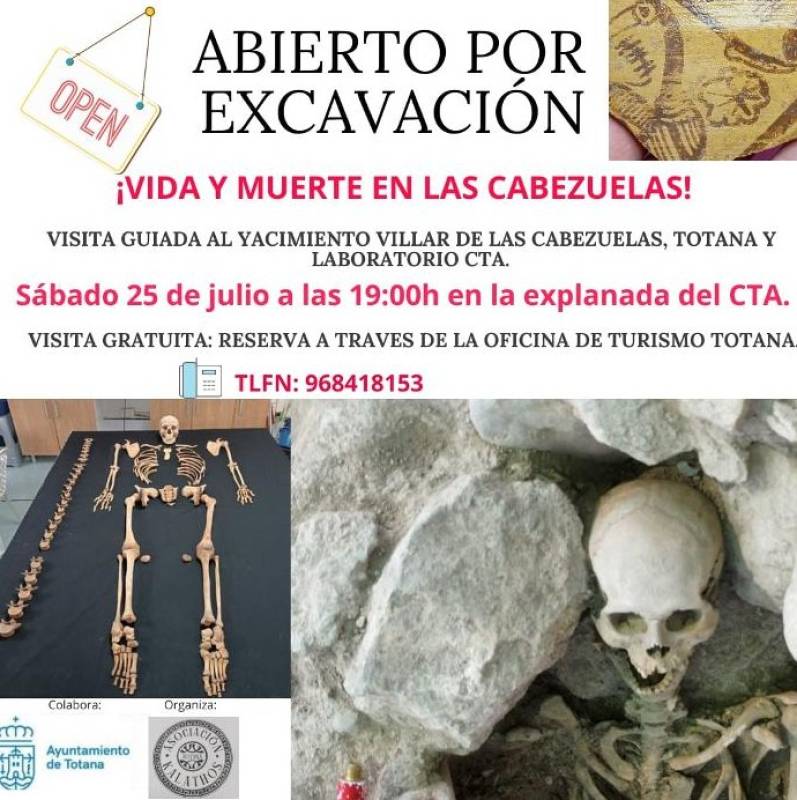
 There is no doubt that the archaeological site par excellence in the municipality of Totana is La Bastida, dating from around 4,000 years ago and sometimes referred to as “The Troy of the West”, but this guided tour on Saturday 25th July offers a chance to see and learn a little about another fascinating place which has only recently begun to reveal the secrets of life in the area in the times of Moorish rule and beforehand, dating back to at least the 6th century.
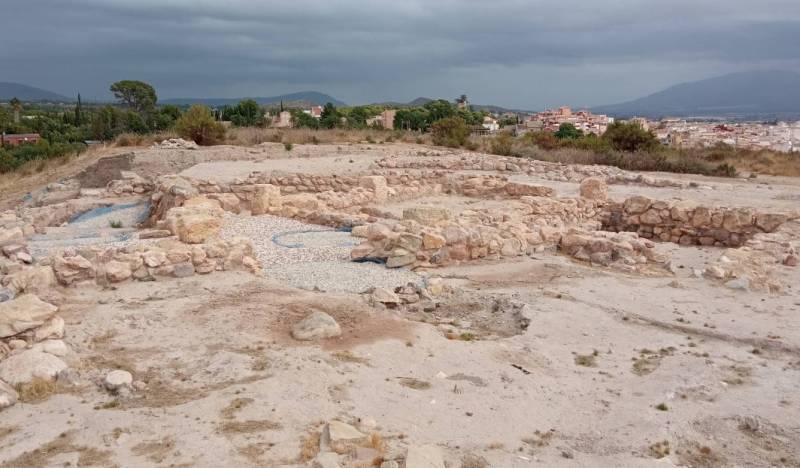
Among the discoveries made at Las Cabezuelas, just outside the built-up area of modern Totana, are the remains of two men who died here around 1,500 years ago, and these have been analysed in depth to provide fascinating insights into the hardships of rural life here in the days before the Moors even arrived. The settlement is on raised ground near the course of the Rambla de la Santa, which at the time was a full-blown river, and was inhabited continuously for as long as 3,000 years or so. It is thus possible to dig down through the layers and find vestiges of the Bronze Age, as well as the Iberians, the Romans and right up until the establishment of Al-Ándalus.
Although much of the site was spoilt by ill-informed agricultural practices in 1972, the archaeological digs restarted in 2014, since when artifacts recovered include high-quality ceramics dating from the 9th and 10th centuries and indications that the settlement was connected with the most important cities of Al-Ándalus, such as Granada and Córdoba.
But the most exciting discovery was made at Christmas in 2024, when investigators were surprised to come across a human skull. Further digging revealed two carefully prepared graves which have been found to date from the 6th century, around the time when the Byzantines reached the Iberian Peninsula in 552 AD.
 Further analysis reveals that the first skeleton was of an individual aged between 27 and 29, and dental characteristics showed problems of malnutrition. The other was around 40 years old, and again his skeleton showed signs of prolonged suffering but, amazingly, with no sign of arthritis. It was then found that he had suffered other kinds of bone disease, while an injury to the ribs suggests that foul play may have been involved in his death.
The guided tour on 25th July begins at 19.00 outside the old Centro Tecnológico de la Artesanía (click for map) and bookings can be made through the tourist office of Totana (telephone 968 418153)
For more upcoming events in the Region of Murcia go to the What’s on section of Murcia Today.